
IP ARCHITECTURE
From Booked-Out Expert to Licensable Culture System
How Willhouse Global turned a founder‑centric DEIB practice into the Culture of Belonging Framework: a stage‑based, licensable culture system that grows beyond the founder.
Will was a booked‑out DEI expert doing roughly a quarter‑million a year—but he was the business, with nothing to sell and no way to grow without more of him. Instead of bolting on a membership, we turned his Culture of Belonging work into a named framework, a three‑stage maturity model, and a licensable, per‑seat culture system that orgs can run without him in the room.
Problem
A highly capable DEIB founder was booked and busy but completely founder-dependent with no scalable business model or product beyond his presence. Revenue was capped and growth was tethered to his time, meaning no predictable path to expansion.
Intervention
We codified his intellectual capital into a named framework and maturity model, reframing his work into a multi-stage transformation system that could be delivered and licensed without him in every room. We shifted positioning from variable emotional framing to executive-oriented outcomes and structured offers that align with organizational needs.
Result
The business now owns a licensable Culture of Belonging system with a clear maturity model, multiple delivery vehicles, and renewal logic built in, enabling recurring revenue and growth independent of the founder’s direct time. Other consultants can execute the model, and the business has a scalable, sellable asset rather than a time-bound advisory.
Where We Started
Promise + Program
Dr. William Lewis, founder of Willhouse Global, came in at roughly a quarter‑million a year and “booked and busy” by any conventional metric — but also completely capped. He was the business, which meant there was nothing to sell and no way to grow that didn’t involve adding more of him.
At the same time, he was exploring memberships as the obvious next step after spending time in membership‑centric circles, hoping that a new container would let him serve more people without burning out.
What he actually needed wasn’t a different format for his time; he needed a clear promise and a program that could exist independently of his personal presence.
Saying No To The Wrong Growth Model
On his discovery calls, most advisors were eager to help him design a membership.
Our first strategic move was to tell Will a membership wasn't the right model: a membership model would have made him more central, not less, and it wouldn’t create anything a future buyer could truly acquire. Being B2B, the scalable opportunity indicated a different offer model - licensing.
The uncomfortable diagnosis: Will didn’t have a revenue model problem, he had a transferability problem.
His outcomes lived in his head and his presence, not in a repeatable, teachable framework that others could execute against, which meant no one else could reliably deliver “Will‑level” results.
Codify the method
Distilling the Culture of Belonging Framework
The real work began with getting Will’s expertise out of his head and into a structure.
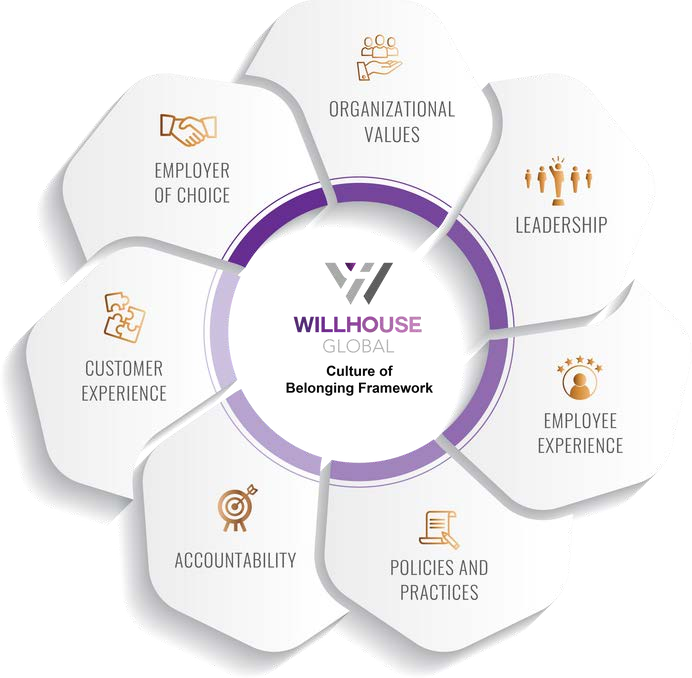
Together, we articulated the Culture of Belonging Framework — a visual, systemic view of how organizational values, leadership, employee and customer experience, policies and practices, accountability, and “employer of choice” status interlock to create belonging.
That framework became the backbone for everything else:
- An assessment orgs could complete with or without Will in the room.
- A way to standardize discovery, diagnosis, and recommendations across clients.
- The raw material for content, training, and future licensing assets.
Altitude & Stages
Designing a 5‑year Maturity Journey
Next, we shifted the altitude to a longer horizon by creating a five‑year Culture of Belonging Maturity Model with three stages: emerging, developing, and transforming.
Instead of seeing his work as a short DEI engagement, clients could now locate themselves on a journey from “interested in belonging” to “industry leaders whose cultures are a competitive advantage.”
Each stage came with distinct offer shapes, all powered by the same core framework:
-
- Higher‑touch support for emerging orgs finding their footing.
- Scaled programming and facilitation for developing orgs building consistency.
- Licensing and more strategic partnership for transforming orgs ready to lead their industry.
Reframing The Positioning
Meanwhile, the category around “DEI” was getting brittle; what once read as moral leadership now triggered fatigue, risk‑aversion, or backlash. Will’s original messaging leaned heavily on the emotional and ethical case for belonging, which resonated with some champions but often stalled with executive decision‑makers.
We helped him adopt a marketing lens for his PhD‑level IP: preserve the integrity of the work while changing the story.
His positioning shifted toward high‑performance cultures, employer‑of‑choice status, and industry leadership — with belonging as the mechanism rather than the headline, reflected in his current public messaging.
Practice Into Product
With the framework and maturity model in place, scalable products that had been invisible before suddenly became obvious.
One of the first: Will’s facilitation of belonging exercises, packaged so organizations could license them on a per‑seat plus per‑org, annual basis instead of only hiring him as a bespoke consultant.
A pilot with roughly 25 seats over six months validated the model and proved that his methodology could deliver results without him in every room, orgs would invest in recurring access to the system, and licensing could stack on top of consulting rather than replace it.
In parallel, Will deepened documentation and began training another consultant in his method — the early emergence of a train‑the‑facilitator path.
“We were running on fumes and had no system to replicate our work. Starlight helped us raise our prices, build a formula we could scale, and grow revenue without burning out.”
Hear Will share how shifting from ‘more clients’ to a multi‑year transformation system changed his business.
Capacity + Culture + Visibility
Building Momentum
Once the promise and program were solid and delivery vehicles were defined, the work shifted into building Momentum:
Capacity: Documenting core processes, clarifying how the Culture of Belonging Framework is delivered, and onboarding another consultant so Will was no longer the only viable implementer.
Culture: Translating Will’s Culture of Belonging vision into the design of the product — offers, touchpoints, and client journey — so belonging was built into how the work was delivered, not just how it was described.
Visibility: Creating a flywheel of webinars on signature framework topics that fed into a nurture experience, a lead‑qualification survey, and a recurring “state of the industry” data‑gathering effort that became an annual whitepaper.
Momentum is never about louder marketing; it's about setting wheels in motion that keep the system moving while staying true to the vision, without constant herculean efforts.
Attract + Retain + Regenerate
Installing Elegant Systems
With momentum building, we began hardening the Systems layer around the work:
Attract: A visibility engine anchored in the Culture of Belonging Framework—webinars, talks, and thought leadership that all pointed back to a coherent method rather than scattered topics.
Retain: A five‑year, three‑stage maturity roadmap that made renewals and long‑term engagements the logical path, giving clients a clear sense of “what’s next” long before a contract ended.
Regenerate: Assessment data and annual whitepaper insights feeding back into proof, pricing power, and product decisions, turning Will’s system into a living evidence base instead of a static model.
With these systems in place, ongoing care could be delegated to his VA and delivery partners, leaving Will focused on high‑leverage work instead of propping up the entire operation himself.
Systems aren’t about automation for its own sake; elegant systems remove the constant background fear that something vital is slipping through the cracks and surface opportunities that would otherwise disappear into noise.
Massively Impactful
Willhouse Global
Willhouse Global no longer looks like “a brilliant DEI consultant with too many clients and no way out.” Instead, it owns a Culture of Belonging system that:
- Lives in a named framework and maturity model that others can see and understand.
- Can be sold as per‑seat and per‑org licenses on annual terms, with renewal logic baked in.
- Can be delivered by people Will trains, not only by Will himself.
He still brings his depth into the work— but the business no longer relies on his presence in every room, and there is now something tangible to grow and, one day, sell.
This is what it looks like when the Massive Impact Framework runs straight through from “I am the business” to “I own a system that can scale and stand on its own.”
Expertise at Altitude, Impact and Scale
You can keep white‑knuckling a business that only works when you’re in the room, or you can do what Will did and turn your work into an ecosystem other people can run. If that’s the crossroads you’re at, let’s talk about what a Culture‑of‑Belonging‑level transformation looks like for your IP.
Book a Discovery Call →
