You just spent all this energy growing your membership. Stop letting them watch — put them to work.
There's a moment most community builders hit somewhere between month six and year two.
Engagement is happening, but you're the engine behind all of it. You're showing up to every thread, running every event, holding the culture together with sheer force of will. And somewhere in the back of your mind, you're doing the math: this is not scalable.
The instinct most people follow at this point is to hire, automate, or systematize their way out of founder-dependency. And those things have their place. But there's something that comes before any of that, and it's sitting inside your community right now, waiting to be activated.
Your most engaged members are more than your best members. They're a leadership layer you haven't built yet.
Why Your Inner Circle Members Are a Design Problem, Not a Loyalty Reward
Most community operators treat their top members like a VIP tier. They get early access. They get shout-outs. They get the occasional DM. The relationship is: you're a great member, here's a discount.
This is a missed opportunity at the design level.
Your inner circle members aren't looking for perks. They're looking for proximity and purpose. They want to feel like they're genuinely part of the thing they've invested themselves in — not sitting in the front row of your audience, but standing with you in the work.
When you treat them like VIPs, you're acknowledging their loyalty.
When you give them a role, you're honoring their identity.
Those are two very different things.
Only one of them builds a community that can outlast you.
The Science Behind the Inner Circle (And Why It Applies to Your Membership)
In the 1990s, British anthropologist Robin Dunbar identified something important about how humans structure their relationships. His research — now widely known as Dunbar's Number — found that our brains have a cognitive ceiling on how many stable, meaningful relationships we can maintain at once. That ceiling sits around 150.
But the more interesting finding wasn't the ceiling. It was the layers beneath it.
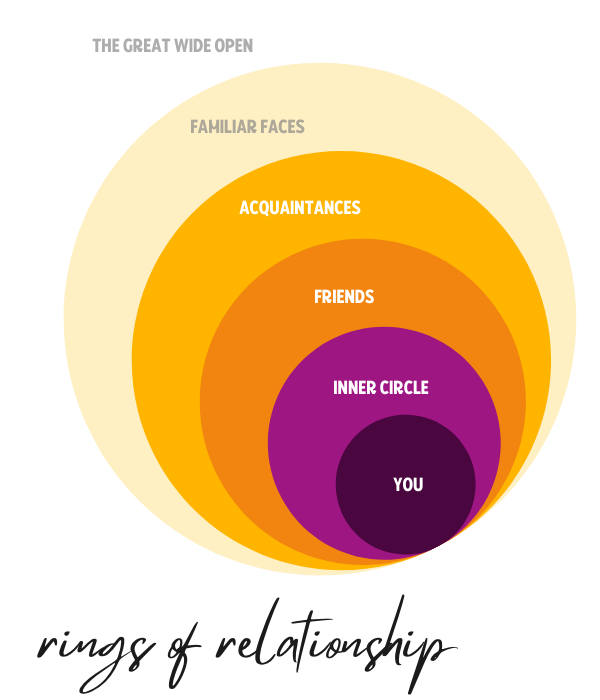
Dunbar identified an innermost core of roughly five people to whom we devote about 40% of our available social time, and an additional ten people to whom we devote another 20% — meaning roughly two-thirds of our social energy goes to just 15 people. Wikipedia
These aren't just "close friends." They're the people for whom we'll reorganize our priorities. The ones whose texts we actually answer. The ones who shape our sense of belonging to the groups we're in.
In a membership community, your inner circle members occupy this same psychological real estate in relation to your space. They're not the 150 people who have accounts. They're the 5–15 who show up consistently, refer people without being asked, and feel the community as an extension of their identity.
What Dunbar's research tells us about them: to achieve longevity, larger groups will develop communities of more meaningful connections — the inner layers are where cohesion lives. ModelThinkers
The good news? You don't have to manufacture that cohesion. It's already forming, whether or not you're designing it. The question is whether you're intentional about it.
The Reframe: Your Inner Circle Is Not a Reward System. It’s Infrastructure.
Here's the shift that changes how you build:
A traditional VIP model says: "These are our best members, let's give them something special."
A distributed leadership model says: "These are our most capable cultural stewards. Let's give them something real."
The distributed leadership layer isn't a tier. It isn't a badge. It's a functional part of how your community operates — the people who hold the culture when you're not in the room.
Done well, this layer does three things your team cannot do at scale:
It makes new members feel seen immediately. A warm, genuine welcome from a peer lands differently than an automated sequence. Members who've been through the journey know what a new arrival needs — and they can deliver it in a way that feels human because it is.
It keeps the culture alive between your events. The spaces between your live sessions and events are where most communities go quiet. A distributed leadership layer is the people who keep the energy moving — asking questions, affirming wins, holding the ritual.
It gives you redundancy you didn't have to hire for. When you're sick, traveling, or just need a week off, a leadership layer means the community doesn't stop. The people you've activated can hold the space. That's not just scalable — it's sustainable.
The Four Move Formula (At Every Scale)
The moves that activate an inner circle aren't new.
At the Fortune 500 level, inner circles power customer advisory boards, practitioner councils, champion programs, and the kind of distributed community ecosystems that companies like Figma, dbt, and Atlassian have built category-defining growth on. The strategic intent and the volume change depending on your size and sophistication.
The formula across scale is identical:
1. Spotlight their expertise. Make visible what they know. Give them a public stage inside your community — not a trophy, a microphone.
2. Connect them to each other. Your inner circle members often have deep relationships with you, but not with each other. When you create conditions for lateral connection, something structural shifts: the community stops being founder-dependent and starts becoming self-organizing.
3. Turn users into teachers. Your most engaged members have learned real, hard-won things that would be genuinely valuable to the people coming up behind them. Give them a pathway to share it.
4. Make contribution visible. When someone contributes and it goes unacknowledged, they don't contribute again. When contribution is named, highlighted, and celebrated — it models behavior. Other members see it and think: that's who we are here.
At the enterprise level, these four moves require dedicated headcount, structured programs, and multi-year roadmaps. At the founder level, they can happen through a single monthly ritual — one featured member, one structured conversation, one story made permanently visible in your community's culture.
Same moves. Different volume. The leverage is real at both ends.
The Three Roles That Make It Work
Not everyone in your inner circle is built for the same function. Trying to give everyone the same role usually results in none of the roles being taken seriously.
Instead, identify three archetypes and invite people into the one that fits them:
1. The Welcome Committee These members take personal responsibility for reaching out to new members with a genuine, thoughtful welcome — not a template, not a copy-paste. A real connection, from one member to another. This is the role that transforms onboarding from a sequence into an experience. Even one or two people filling this role consistently will change the energy of your first-30-days.
2. The Cheer Squad These are your intentional engagement crew. They show up to threads, questions, and wins — not just with likes, but with specific, warm, generous responses. They're the vibe-setters. The people who make your community feel like a place where being seen is the norm. Engagement rates go up when this role is filled by someone who's intrinsically motivated to do it — because they love the community and love the people in it.
3. The Ritual Keepers These are the members who know how to run a specific recurring event or ritual in your community — and can either add more sessions or cover you when you can't be there. This role is *chef's kiss* for scaling culture, because it decentralizes the thing most founders hold too tightly: the experience design.
These three roles don't require a committee. They don't require job descriptions. They require intentional invitation — and a conversation where you ask rather than assume.
The Mechanism: The Inner Circle Creativity Session
So how do you identify who fills what role, build the connection between inner circle members who may not know each other, and actually extend the invitation?
You run what I call an Inner Circle Creativity Session.
This is a small, intentional gathering — virtual or in-person — of eight to ten of your most engaged members. Not a webinar. Not an event. A conversation with the people who know your community best.
It serves three purposes simultaneously:
- Introductions. Your inner circle members probably know you well — but they may not know each other. This facilitation method creates those lateral connections, which matters enormously for community resilience. A community where the inner circle members are connected to each other is far more self-sustaining than one where all roads lead through you.
- Research. You're going to ask them real questions — about where they are in their journey, what's working, what's missing, what ideas they have, what they're excited about. This is qualitative gold, unfiltered, from your most invested people. The intel you get from a single inner circle session is worth more than most surveys you'll ever run.
- Invitation. At the end of the session, you extend a formal invitation into one of the three roles above. Not an ask for volunteers — an intentional invitation to specific people based on what you've just learned about them.
The logistics that matter:
Keep sessions to no more than ten people. Run them three to four times per year, rotating in new inner circle members as your community grows. After each session, feature the participants — they just handed you everything you need for a compelling member spotlight. And at the end of each session, preview something new and exciting that came directly from intel gathered in a previous session.
That's the full loop: your inner circle shapes your community, and your community knows it.
I've run versions of this inside communities with forty members and communities with thousands. The mechanics don't change. What changes is how much richer your culture becomes over time — and how much lighter your operational load becomes.
The Compounding Effect: What This Looks Like at 18 Months
The single session is valuable. The system is transformational.
When you run Inner Circle Creativity Sessions consistently, something structural starts to shift inside your community:
Your culture becomes self-sustaining. The Welcome Committee handles onboarding warmth. The Cheering Squad handles baseline engagement. The Ritual Keepers handle recurring experiences. None of this requires your direct involvement for every instance.
Your research function gets built in. Every session generates qualitative insights that inform your product, your programming, and your positioning. You stop guessing what your members need because you have a recurring mechanism for asking.
Your community becomes a single point of strength instead of a single point of failure. That's not just a retention strategy. That's a business model shift.
A Note on Why This Works (And Why Discounts Don’t)
I want to name something directly, because it comes up every time I introduce this framework.
The instinct many community builders have is to reward their inner circle with discounts, free months, or exclusive perks. And those things aren't inherently wrong. But they signal a specific thing: you are a customer we value.
What inner circle members actually want is to be recognized as co-stewards — people who matter to the thing they've invested their identity in. Proximity signals that. Purpose signals that. A discount doesn't.
When you give someone a role and invite them into a real conversation about the community's future, you're not just rewarding loyalty. You're creating it. That's the distinction that changes retention from a metric into a byproduct.
Frequently Asked Questions
What if I don't have obvious "inner circle" members yet?
You have more than you think — look at who shows up consistently, who welcomes others organically, who DMs you with ideas. If you genuinely have fewer than five, the session is even more valuable: it crystallizes the culture and gives emerging leaders a place to land.
How do I invite someone without making it weird or formal?
Keep it simple and specific. "I'm pulling together a small group of members I deeply respect to have a real conversation about where we're going — I'd love for you to be part of it" is enough. The specificity of the invite is what makes it feel like an honor, not an obligation.
What's the difference between this and a focus group?
Focus groups extract information. This session does that and creates connection between members and extends meaningful invitation. It's a three-purpose gathering, which is why it's more efficient than running research, community events, and leadership recruitment separately.
How long does a session need to be?
60–90 minutes. Long enough for real conversation, short enough to stay focused. Have a loose structure: introductions, research questions, invitation. Don't over-facilitate. The conversation usually goes somewhere useful on its own.
The Member Feature Fix Pack pairs directly with this framework — it's the system you use to spotlight the members you identify in your Inner Circle Creativity Sessions. The session finds them. The feature activates them publicly.
→ Get the Member Feature Fix Pack